Friday, November 6, 2020

Starting a New Series for Parents Providing Treatment for Low Weight EDs at Home

 I realized yesterday that I have a higher than average percentage of teen clients at this point, and one of the biggest challenges in treating teens is that my job is to teach parents how to treat an eating disorder. This is no small feat for parents, as where, in that mythical parent school, did you supposedly learn how to treat an eating disorder?! And yet, here you are, living with an eating disorder that has taken over your child. It is a terrifying position to be in, and it will be one of the most difficult things you have ever done. But, it is also possible, effective, and, in the end, can be rewarding. I promise I'm not just saying that; this comes from years of helping parents do this exact thing.

The hardest thing about suddenly living an eating disorder is the reality that they hijack your child and turn him/her into someone you don't always recognize. Kind, well-behaved, honest kids begin to lie, manipulate, call you names, and express their hatred. My goal is to try to explain how the ED works, what essentially is likely going on in your child's head, so maybe the nonsensical can start to make just a bit more sense. Other resources, however, include Lock and LeGrange's "How to Help Your Teenager Beat an Eating Disorder," and AroundTheDinnerTable.org.

The idea of Family Based Treatment, which, to me, amounts to creating an ED treatment center in your home....no big deal, right?!....is to keep teenagers out of higher levels of care and allow them to remain at home with their families (even when they say they hate you). There are pros and cons to FBT and to treatment centers, and both are very good options. I won't try to speak for the creators/advocates of FBT, and I will fully confess that I do not follow closely how Lock and LeGrange described the treatment. I use the tenets that I have found work, and adapt the rest. For example, FBT initially called for no involvement from a dietitian, and I have never agreed with that. Due to the changes that happen during refeeding, I have always felt expecting parents to know what to do 100% with food was too high an expectation. I believe they have since loosened that messaging, but this is just an example of ways in which I have adapted the approach over the years.

I fully agree with the basic tenet that eating disorders CAN be treated outpatient, and I absolutely believe every patient should be given the opportunity to give it a try. I do not believe in a patient being diagnosed and immediately sent to a treatment center, unless that is what the patient wants. Many, many patients and families have succeeded at home, but it is definitely a lot of work. And parents need a lot of support as they experience a lot of unexpected hostility and anger from their child. I always take into account when that hostility and anger becomes too much either for parents or for siblings, and that becomes grounds for referral to a higher level of care when necessary. 

If your child is referred to a higher level of care, it is not failure on your part! Some eating disorders are unbelievably nasty, and sometimes, overcoming them at home is simply too high an expectation. One of the key parts of eating disorder treatment is empathy not only for your child, but also for yourself. And, eventually, I will work with teens to recognize how much they need to empathize with their parents and the terror they have experienced while watching their child suffer. Good news...all the teens so far have come around to recognize how hard their parents worked, how scared they were, etc. Your kid may hate you now, but it's not forever!

Some of the things I will talk about in this series have been addressed previously, but I still am going to go over these things again, just so it is all in a string. If you are reading this and have something you want me to address, please feel free to email me at whoytphd@gmail.com, as I don't necessarily check for comments here (I know, I'm a poorly behaved blog writer. I thoroughly enjoy sharing this information; I do not thoroughly enjoy social media!😉) These blogs will also be sans pictures and images and the like, simply for the purpose of conserving my time! I hope you find this series to be helpful!!!

Wednesday, November 4, 2020

Tenacity and Facing Fears


The other half of my life (and it does feel like it takes 50% of my time!) is being an equestrian. As I share with my clients often, I too was gifted a healthy dose of anxiety, which I address through multiple paths. One of those paths is riding horses. I can have a million thoughts going through my head, but riding demands enough of my brain to, you know, remain on the horse, that it forces out all the other thoughts. Well, that is not COMPLETELY true. Part of my anxiety is social anxiety, so that still comes up when I am involved specifically in my sport, which is dressage. (Most people have no idea what it is, and I cannot easily explain what it is, soooo ask Google?) But I definitely have to battle a health amount of social anxiety as I fumble around in this sport.

I started riding horses in 2013. I mean, I had ridden horses occasionally before, but never in any type of informed way. So, I started riding February of 2013, and by May bought my first horse (advisable? Probably not....but she stole my heart.) I rode Daisy for a year, and started conducting equine assisted psychotherapy with her as my co-therapist. Then another horse was coming into the barn; I took one look at her picture and somehow just knew that she would be an excellent co-therapist, and also that she was meant to be mine. I cannot explain it; it just seemed true. When she arrived, it only became more clear to me, though my husband, reasonably so given the cost of horses, was less convinced. ;) But here's the kicker: Violet had never been backed (often referred to as "broke"). Nobody had ever ridden her. So, sure, that's a great plan....let's take the brand new rider and have her buy an unbacked horse. Yep, great idea. (Hint: it's not a great idea and literally nobody advised this.) Neither of my horses now were typical dressage horses, but someone did say that V could like make it to Grand Prix (the highest level of the sport). So, stubborn ol' me decided that the really bad idea was still what was going to happen, and I bought her a couple months later, and she was started under saddle in spring/summer 2014. 


This pic is an example of the early not-very-good riding. I basically am just sitting up there hoping for the best!

I started to train in dressage in early 2016, and first showed in summer 2016. Let's just say it's been a rough road. Perhaps the main thing I learned from Violet was...how to not fall off...and persistence. That horse can change directions at the speed of light and so from seemingly Day 1, I just had to figure out how to stay on. I had a number of near falls where I literally would be shooting off her side, but would hook my boot under the saddle and pull myself back on her, because, let's be honest, hitting the ground hurts. I have no doubt that everyone watching the debacle of new rider riding new horse was thinking, "What does she think she's doing up there? She has no idea what she's doing." It was true! I didn't have any idea what I was doing. Normal, sane people buy horses that already are trained; that wasn't me. I was just stubborn, I guess.

This pic illustrates getting the job done, but not competently. Leaning forward, horse unhappy.

In 2018, I took a huge risk and started bringing Violet out to San Diego so she and I could train with high level riders....international riders.....another massive challenge to the social anxiety. "Hi, don't mind me over here on the small horse (dressage riders are generally tall, and on tall horses) and no, I don't really know how to ride, just to be clear!" My very first ride in San Diego, I had to go into a ring with an Olympian and the next-in-line for the Olympics. Right. "Don't mind me. No, really, don't look at me. Please." By that time, I had made it up to showing third level, which wasn't too bad, and also means nothing to anyone who doesn't do dressage! (I tried to figure out how to explain the levels 
to my mother the other day, and this is what I came up with. You start out as a high school athlete (Training level and first level), then you become a college athlete (2nd and 3rd level), and then you make it to the minor leagues (PSG and I1), and then you are in the big leagues (Grand Prix). And then those who really excel in the big leagues go to the Olympics.) But I was a college athlete that had never been really taught how to do the sport correctly; I just kinda fumbled through doing it on a fairly fancy horse and so did acceptably enough, but I was not doing it correctly. Then I started training with Emma Weinert, an international Grand Prix rider. I returned to San Diego this winter to train with Emma, and then life happened and suddenly we were looking at moving somewhere, so we might as well consider San Diego so I could work with Emma full-time. 

Fast forward to this weekend. I had spent two years (Nov 2018 to now) trying to learn how to ride correctly, and did not advance up the levels as I worked on that. It was a lot of work as I had to completely change how I rode in order to do it correctly. But I had gotten lucky, and did indeed have a very talented horse, who also is quite unpredictable. 2020 happened, and horse shows were no longer a thing, so my focus was on trying to advance to PSG (Prix St Georges, if you are super bored and want to google), which I have equated to the "minor leagues." My eyes were set on a show called Spooktacular, which was 10/31-11/1/2020. We were gonna do it, no matter what, I thought. Then life threw enough barriers that by 10/27/20, I was being thrown around on horseback and said sadly, "I can't take this (extremely wild animal) into the ring this weekend." Violet had ulcers and had become aggressive and violent. I had given up about 40% and then started Google Image-ing "Persistence." I couldn't really find any quotes I liked, but one thing led to another and I found quotes about "Tenacity" and that is what felt right. And also seemed to describe what one with an eating disorder must have in order to recover. 

That night, I threw one final hail Mary in the form of very expensive medication at her, followed by another dose first thing on Wednesday, and somehow it magically made her sane (it really shouldn't work THAT well, especially since she had been on a less expensive version of the exact same medication). I cautiously thought, "well, maybe?" The next day, Thursday, she was okay again, and I thought, "Well, I guess so?!" And Friday we left for the show, where she also was good. BUT, we had never actually practiced for our "minor league" debut, as she had been that aggressive horse for the past three weeks. Just the next inadvisable thing in line, I guess! Somehow, I had confidence that it'd be fine. That was quite misguided confidence, I'll have you know! ;)
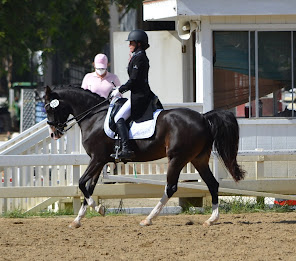
It was basically fine....if you don't have social anxiety, perhaps. I did ride into the show ring on both Saturday and Sunday. We completed the tests without any major issues other than that tiny rear in the back corner of the arena on Saturday (just to be clear, at no point does a dressage test call for the horse to rear, whether tiny or large, so that's a bit of problem). The judge skewered us in her written comments; my social anxiety took off at a gallop! I pondered dropping out of the show for the next day. Some kind friends talked me off the ledge, and we gave it a go again on Sunday. Was it significantly better? Yes, and no. No rearing is always a plus, of course, so that was cool. But again, I knew our score would not be particularly desirable. But this time, the judge's comments were fair and constructive, so the low score was way more tolerable. We had survived. We had done the inadvisable, and we had received a lot of encouragement along the way, and I would not have experienced those things if I had listened to my anxiety and bailed. There were some really cool moments, and a lot of errors. But, we had made it in the ring, she stayed in the ring, I stayed on the horse, and we played the sport in the most basic of senses, on a much larger stage than we had ever been in, with huge room for improvement. Let's just say we wouldn't be chosen as a starter in the minor leagues. We need a bit more practice. ;)

What, you might be thinking, does any of this have to do with eating disorder treatment. Well, let's go back to that Tenacity quote: 

This quote drove me from Tuesday on in the battle to make it to something quite unimportant in the scheme of life...a horse show. This same quote, in my opinion, describes the experience, the process, of eating disorder treatment and recovery. The patients I work with must trust that we, as the treatment team, can share a game plan and a strategy, while they bring the strength and the determination. And it is hard to feel strong while fighting an eating disorder. It is hard to feel determined when there's a nasty voice in your head saying to give up, to not listen nor believe in the game plan. The statistics about eating disorder recovery present as "seemingly insurmountable odds," and certain the ED voice in your head feels insurmountable. But the odds are NOT insurmountable. As I say frequently, I could not do this job if my clients did not recover. I'm not crazy (Hmm, to those of you who know me, keep your opinions to yourself, LOL!). Ok, I am kinda crazy. But I'm not willing to work every day to treat something that is untreatable. Everyone can get better. I don't doubt that for one second. But it sure takes a ton of persistence, stubbornness, and tenacity.

Same message for anxiety. Anxiety also convinces us that thing that are not true, are true. My anxiety convinced me I was being judged left, right, and center. I mean, I was technically being judged...by the judge....but I eventually realized all the witnesses were not judging me as harshly as *I* was judging me. So, simmer down, brain. Anxiety almost led me to not go back in the ring on Sunday, but in the end, I would then be a hypocrite as I allowed anxiety to stop me from facing the fear of judgement. And, sure enough, Day 2 wasn't as bad as Day 1. And even it was terrible and everyone judged me harshly, let's be honest, for me, as an amateur, it's "just a horse show." And lots of times the things we are fearful of are just not that big a deal in the long run; our brains are lying to us. And the only way past, is through. You must prove your anxiety wrong, and it is wrong the vast majority of the time. Whether that is proving that eating x,y and z won't make you gain x amount of weight, or whether failing on x activity does not make you a failure at life. Eating disorders lie, anxiety lies, and you can be tenacious enough to prove that to be true. 


Tuesday, November 3, 2020

Treating Eating Disorders and Trauma via Telehealth


Had anyone ever said I'd eventually move out of Utah and work in another state, I would have adamantly denied that was a possibility. My work, and the practice I created in Utah, was, and is, a huge part of my identity. But, sometimes life happens, and you are put in a position to which you must adapt. 

And so, adapt I did. And also, adapt, the clients I work with, have done. It has been incredibly rewarding to have the gift of being able to continue to treat the clients I was treating in Utah. I was not sure whether telehealth would really be an effective means for treating eating disorders and PTSD, but it has been effective in the majority of cases. I believe a big part of it working, both for my clients and for myself, is the fact that I return to Utah with some regularity. There have been a handful of clients over the past two years for whom I have not felt telehealth was a viable option; those clients I have referred to in person therapy. 

When I first moved, I in particular thought my days of treating adolescents might be done. In my, apparently old, brain, I thought the disconnection inherent in telehealth would not work for teenagers. However, after my first week, I realized, "Oh right. Teens spend lots of time talking to people virtually. Especially during a pandemic!," and my fears of not being able to work with teens were proven to be wrong. I have a higher portion of teen clients than ever before, in fact. A large part of that is due to working closely with an excellent physician, Dr Nikki Mihalopoulos (fortunately, she goes by Dr Nikki....cannot imagine why!). In addition, continuing to work closely with Andrea Addley, RD and Primary Children's Nutrition services has made all the difference. Whereas I am no longer able to fully "lay eyes on" my clients all the time and detect concerning changes, I have these local providers that communicate with me so well, so I am able to continue to do what I love to do.

I truly miss seeing my clients in person every week. Yes, there are positives to doing telehealth! My commute is the best ever, especially since our house is relatively small, so the walk from the bedroom to the office is quite short, LOL! California living! And as we go along, probably most clients will get a "co-therapist" bombing sessions at some point. Mao, the cat, is excellent and sticking his, ummm, self in front of the camera, or sitting behind my head and looking on, potentially judgmentally, because he's a cat. Ruckus, the aptly named Australia Shepherd, participates in session whenever delivery people dare to approach the house, and Maizy, the Bernese? Well, she actually is pretty respectful and will just camp out on the floor quietly. 

I am fortunate in that the lack of commute to work and the shortened commute to participate in my hobby makes it so I can go to the barn every day. As time continues to pass, I will eventually develop a means for working with anxiety in equestrian athletes, but for now, I'm just soaking up the horse time and continuing to work with all of my Utah clients. I don't foresee building an eating disorder practice in CA anytime soon. I'd rather commit my time and energy to Utah, where there are not enough resources for eating disorder treatment, and I am ever thankful for my treatment team partners, and my clients, who allow me to do so!


Sunday, June 7, 2020

Pursuing Passions: Career AND Personal (Plus, some local horse-related recommendations)

Big changes are coming up for me and my practice. The story of how I have gotten to this place is one of those "what are the chances" kind of situations. But, as life has developed over the years, I have gotten more and more to where I believe that if something falls in your lap, you should go with it, and so here we go!

At the end of this month, I will be moving to California. Now, to my clients, it seems like I actually planned this, and kept it hidden, but that's the crazy part...I sure didn't! One of the things I talk to clients working towards recovery about is pursuing passions, as we know the ED kills those passions by taking time, energy and pleasure away, while focusing almost solely on the ED. Last year, I decided I wanted to go get better training in dressage, and so I went back and forth to San Diego for about six weeks; I would work during the week, and then fly to SD for the weekends. It was craziness, as I got to where I lost track of where I was and what I was doing...also, what season it was, since I was doing this in February!

So, this year, I decided to take the risk of upsetting my clients, and I set plans to go to SD for 5 weeks, continuing to see clients via telehealth. I was shocked when all of my clients took it in stride. All these years, I had told myself these stories about what would be upsetting to clients, and I avoided doing those things as much as possible. So, I learned a lot there that, as I tell clients all the time, I'm not actually psychic. ;)

Again, this was in February, so before COVID-19. My clients and I learned together that telehealth could work okay, though I do believe it should not be used with ALL clients. Anyway, I never intended to continue doing telehealth after returning from California. But, I returned right as COVID-19 hit and California and Utah shut down, so I guess the joke was on me!

After getting to San Diego in February, and enjoying the warmer weather, I had told my husband that we needed a 5-10 year plan for moving to San Diego; I was mostly kidding, as I also always said I couldn't move until I retired. I have come to hate winter, and, well, the Utah dressage community leaves a lot to be desired. But it was a 5ish year plan. My husband was already looking for another job when one came up in Escondido, which is about 20 minutes from the barns my horses were at. So, on a whim, he interviewed. Then, doors here in Utah closed, and we found ourselves left with the Escondido job versus looking wherever else in the nation. I ride horses, and he loves riding his motorcycle. Soooo, California is what was making sense (as long as you ignore all the downsides of living in CA, LOL!).

So, I returned to Utah, COVID-19 hits, and my husband gets the job offer. After a lot of back and forth on this, given my private practice in Utah, we eventually decided we'd do it...we'd make the move, but it certainly didn't feel real. At the same time, insurance companies decided they'd start covering telehealth given the pandemic. And, my clients had experienced what telehealth was like. It was all extremely strange timing. But, that is the timing that kinda makes you wonder if it is meant to be?? But I still didn't believe it was real. We put our house on the market. We had COVID-19 to deal with, wondering if my husband's job would be rescinded, etc. If you ever really want to have a good time, try selling AND buying a house in another state, during a pandemic. We learned you totally can buy a house remotely, as long as you enjoy high levels of stress! ;)

So, at the end of this month, we pick up our roots here, and relocate to San Diego. I will continue to provide telehealth to clients in Utah forever, or until there are enough ED providers that I don't feel like it is important for me to do so (I can't imagine that will happen anytime soon, sadly). With time, I will build up a practice in San Diego also, including plans for working directly with equestrians. I will be able to pursue my passion for dressage in a healthier environment. I have most definitely experienced the worst that Utah dressage has to offer, but also have had some wonderful experiences with some wonderful people. California dressage will be a whole new level of the sport, and we will be a tiny, tiny fish in a gigantic pond, but it will be so worth it to enter that intimidating environment.

For years and years, I was going to open my own treatment center in Salt Lake City, Utah. I bought the building to do it. I researched and planned, and I was going to do it. Then I got involved with horses, and that allowed me to slow down enough to realize that owning my own program would do two things I did not want: 1) It would make me an administrator, and I only want to work with clients, and 2) it would create paperwork nightmares, and paperwork is the only part of my job I detest! So, I put that dream aside, and moved on to new dreams where I pursued my love for horses and riding outside of work. My life is a wonderful balance now, and as much as I do not want to see my clients less often (I will return consistently for in person appointments, in addition to telehealth), I do feel like I am at least demonstrating what I talk about in therapy....that we must have passions and interests outside of parenting and work. So, onward!

Now, I do want to do some shout outs for anyone looking for resources in the Utah horse/dressage community. If you or your kiddo wants to learn excellent riding skills from moment one (a rare experience), please research Alpine Performance Horses/Jerusha Strikwerda. Her program is extremely high quality and also extremely affordable. For lower level dressage training, look to Rachel Kenyon Ebbens. Best Utah dressage shows: Millbrook Farms. Best farrier on the planet: Marcus Parker. The vets I found helpful were Mountain Point Equine and Morgan Freeman (yes, for real...). I guess that's all I have to offer on recommendations!

One of the things I can only imagine would be hard for my clients to trust is that I truly will return to Utah consistently. And I know only time can confirm that what I say is true. I remain extremely committed to treating EDs in Utah. I know there are not enough resources, and I will do all I can to continue my work here.

Thursday, December 5, 2019

Treating Body Image Concerns

Ahhh, body image! The concept that was completely befuddling for a few years of my career as a therapist. You see, there are so many ways that people have come up with to try to treat body image. There are body tracings, and using visual effects (somehow?!) to try to help those with eating disorders see themselves more reasonably. There are many other approaches, I am sure, but I don't search for them anymore.

I eventually realized, when it comes to body image, I truly have no idea how my clients see themselves, and they truly have no idea how I see them. So, discussing it has very little effect, in my experience. In my thesis, I used some body size scale by Stunkard and Stunkard (clearly, research was a big enough pain that i remember the names all these years later!), but would I ever use that with a client? No.

So then, what do I do when it comes to body image. I would say the main thing that changed my view of body image treatment was being told last minute that I needed to run a body image group at a treatment center I worked at many moons ago. When it's such an intimidating topic, it is NOT fun to hear last minute that it has just landed in your lap. My groups were fairly well known for being "no holds barred" and I sure didn't follow any script. So, as we sat outside, someone asked me something about body image. I don't even know what question I was asked. But, what came out of my mouth was something like, "The way I handle body image is to look in the mirror long enough to make sure I do not look like a freak. I know I won't always like how my body looks. But I tell myself, 'I have sh!t to do,' and I head off to work. Because working with eating disorders is way more important to me than what my body looks like." Now, when you work in a treatment center, or even individually with clients, you never know when what you say has an impact. I don't remember anyone really reacting to what I said in the moment, but over the next few years, I was told about how those words impacted members of the group, and changed their view of body image also.

I mean, we live in the US. Our society/media does not easily allow for positive body image. To try to get someone to love their body is truly fighting our culture. Is it  possible? Sure! Is it my goal? Actually, no. For some, that's setting the bar way too high. My goal is acceptance, a neutral view of their body, but more so, a focus on what is actually important in one's life. The sh!t they have to do.

But, the other piece that I realized along the way was that body image concerns are often an indicator that the person is upset about something else completely. So, I've come to talk about body image concerns as a "translation" of some other emotion. "I'm stressed out about a test at school," or "I'm mad at ___," or "____ hurt my feelings" becomes "I hate my body." And why would I brain do this translation for us? Because if you make it about your body, then theoretically you can do something about it. (Theoretically being the key word here.) If it's about your body, then you can engage in an ED behavior to "do something" about it. It also is a translator for when you don't want to feel. You don't want to feel emotional pain, so you focus instead on your innocent body, and you beat it up.

The body image focus is very "effective" in some ways. It's an incredible distraction from stuff you don't want to think about or feel. But, focusing on your body doesn't change the actual problem, so it becomes this persistent thing that you have to focus on all the time. And that feeds the eating disorder.

These thoughts have come from my own work in this field. I don't know that they are backed up by research, or commonly espoused, though they may be. This is just what I have pieced together through my own experience, and through time with clients, and each time I present the idea, it seems to fit for my clients. So, if it fits for you, use it! If other body image approaches work for you, also brilliant! But, please, stop targeting your innocent body.

I should add...another effective body image approach, in my experience, is becoming an advocate AGAINST our society and its focus on body and weight.

Tuesday, November 5, 2019

The Impact of Changing Identity

I am a bit surprised, looking back at the titles of past posts, that it seems I have not written on this before. After all, it is one of the biggest things faced by those in treatment/recovery from an eating disorder, and it is one of the things that can be really hard for family and friends to understand.

You always hear "self-esteem" as a mental health buzzword, right? But, where does it come from? What is it exactly? I sure don't have the exact answer to those questions, but I do know where part of it comes from, or at least I know where *I* think it comes from. In my opinion, self-esteem is closely linked to our identity, who we see ourselves as being. And that is something that develops over time. Think of teenagers and how prevalent cliques are in high school; why are they such a big deal at that time of life? Well, according to Erickson, the goal of adolescence is identity development. So we see adolescents putting themselves into groups, trying on different identities, and eventually (we hope) picking a path forward based on who they see themselves as being.

And, as I explain to parents frequently, it is really unfortunate that this is a prime time for development of an eating disorder, and the impact of that timing is that the eating disorder can become an identity. This is why you will never hear me say the term "anorexic" or "bulimic," as I will not label someone as their disorder.

Healthier identities will center around perhaps academic/work success, or athletic, musical or artistic success, or maybe will come from religious or political (used broadly here) views. But even those identities can become problematic. If one becomes overly invested in any one part of his/her life, it can then be traumatizing when that identity is lost, just as it can be, illogical as it seems, traumatizing to give up the eating disorder identity. So, think of someone fully committed to their job, or perhaps an athlete whose life consists of training, competing, performing, etc. When that is taken away, whether due to age or injury, it can leave a sense of emptiness and despair as the individual tries to figure out who they are without the career/sport/eating disorder. Anxiety and depression are not uncommon.

So, then what? A lot of the work I do is around finding out what else makes up a person's identity. If you have had an ED for years, unfortunately, it likely makes up the majority of your identity. So it is pretty intensive work to figure out what else will define you moving forward. But it is such important work. As the ED behaviors decrease, that hole must be filled with other things that are meaningful. You might look at what hobbies you used to have that got lost due to the eating disorder. Or, if you are an athlete or consumed by your profession, you might look back at what other things you used to do that you enjoyed; things that got pushed out by the high demand. For some, they cannot identify anything, and that's where the real work begins; the trying out of new hobbies, of new interests, trusting that eventually you will find something just as meaningful.

I can even say I went through this process to a certain extent. I used to work A LOT. My identity centered around being a therapist. And, even now, I can say I would absolutely be traumatized if that identity were to be taken away. My plan years ago was to eventually open my own treatment center, and do lots of training of new providers, while treating lots of patients. When I picked up the first hobby, running, I just did both. I worked a ton of hours, and ran a lot of miles, and nothing really changed. Now, I'd say that's because I wanted to run a marathon, but being a runner was not my identity. Then, horses came along, and the running was dropped pretty quickly, as I had met my running goals. Now, being an equestrian and an eating disorder therapist are pretty equivalent; both mean the world to me, and losing either would lead to significant suffering. But, at least I am more balanced now. I no longer want to open a treatment center as I know I would no longer have time to ride, and to do what I want to do with riding, I have to ride quite a bit (and drive quite a bit, LOL!). So that idea has easily fallen to the wayside. I'm completely content doing the work I do while also taking significant time to drive to and ride at the barn a lot. In fact, I have now started to look at how to combine my passions (beyond doing equine assisted therapy), which is what led me to go back to my therapy beginnings. I went off to grad school in Colorado and wanted to work with the US Figure Skating program; that eventually became unrealistic as I was 3 hours from the training center, and I walked away from the idea of working with athletes specifically. But, now I'm starting to reconsider how I could use my experience in treating eating disorders, and helping people change their sense of identity, to help athletes reaching the end of their careers. Do I ever expect that to be a big part of my work? No. But, it is something that has been, and would be, enjoyable to do.

Changing identity is certainly possible, but it is far from easy. As carers, it is important to understand, as illogical as it might be, how hard it is to abandon the ED identity if it has gotten to the point to where all your loved one thinks he/she is is an eating disorder (and the associated labels). I KNOW it doesn't necessarily make sense, but it is real nevertheless. Sometimes parents get confused why I am talking to their child about their hobbies, when it seems like I should be talking about ED behaviors. In the end, I do both, all for the purpose of achieving true, lasting recovery.

Thursday, October 31, 2019

"I'm sorry" and "dramatic"...tales of avoiding emotions

I hear "I'm sorry" in my office quite often. Which would be cool if my clients had reason to apologize to me. But usually, they don't. They are apologizing to me for crying, for being mad, for being sad, for showing any emotion other than happy, other than "fine." And that's sad. It's sad that we, as people, have learned that it is not quite right to show emotions in front of someone else, that to do so is burdensome. And, probably on a related note, it seems we, as people, have not necessarily learned how to respond when someone does show emotions. I don't know which is the chicken and which is the egg, but I feel pretty confident the two phenomena are likely related.

A linked idea is that of labeling feeling, or expressing emotions, as being "dramatic," or the like. Ask yourself, how often do you see someone showing emotion, and brush them off as being dramatic. How often do you think that versus say it out loud. Now, I live with a teenager, so I most certainly know that sometimes, someone showing emotion is, in fact, being dramatic. But, I also see that we, as a society, default to the "drama" label when really it is that we are having a hard time accepting/dealing with how the other person feels.

Almost without fail, when a client first starts to tear up, they quickly say, "I'm sorry," often with, "I don't know why I'm acting like this," or something of the like. And often, they label themselves as "stupid," or "dramatic." And yet, it never bothers me when people show emotion. In fact, I feel pretty confident that feeling is what makes us human, rather than robots.

So, how do we get to the point where we are no longer showing emotion? I am hesitant to say this next bit, because the last thing I would want to do is come across as the therapists of old, who seemed to default to the "easy answer" of "it's the parents' fault." It's most often nobody's "fault." Things are passed down intergenerationally, and so many different experiences can lead a person to shut down emotions. But, it is true that having parents that are not comfortable with emotion indirectly teaches kids to not be comfortable with emotion. It's generally not the intent, but instead, the fallout.

Certainly, there are some parents that might be very direct about it. They might directly tell their kids, and others in their lives, to stop feeling the way they do, or at least stop showing that they feel that way. They may respond with anger or maybe it is shame that leads them to tell others to "stop it." But the vast majority of the time, it's way more subtle. And it is likely that the parent doesn't even realize that he/she is uncomfortable with emotion, and thereby is teaching their child to be uncomfortable with emotion.

Kids learn to deal with emotion by having role models that show them how to handle them. And, oh my, there are all those memes out there now, from all the child therapy people, that illustrate perfect responses to your child's emotions. Those things make me shudder as the expectation is SO HIGH! I don't personally think the average person can have those perfect responses when his/her 3yo, or 16yo, is having a meltdown of epic proportions. So, please don't hear me as saying you should have those perfect responses. (And, you may respond in shock or dismay in the moment, but you can always go back and "fix it.") But, outside of those epic meltdown moments, your child will learn how to handle emotion as you prove that YOU can handle their emotion. If you are uncomfortable with your own sadness, then you likely will communicate to your child, by accident, that you are uncomfortable with their sadness. That might sound like trying to talk them out of how they feel, just as you try to talk yourself out of how you feel. It might sound like, "Oh, it's not that bad! Look at how lucky we are. There are people who have it way worse." It might sound like, "Oh, don't over-react." It might sound like, "I'll give you something to cry about." And, it might sound like dead silence. I'd say that, a lot of the time, it sounds like trying to talk someone (or yourself) out of the emotion that has arisen. I talk about this in therapy as using the brain to override the heart.

Now, where it gets tricky is that it's not an either/or, so I'm not saying we should never use our brains to manage our emotions. But, I would say that cognitive part, that rationalizing and talking ourself through it, often comes AFTER experiencing the emotion. Not as a means for avoiding experiencing it. The goal is to have both...both the ability to feel, and also the ability to soothe ourselves when our feelings might a little bit off. Anxiety, for example. Anxiety tells us all sorts of lies; we may have fear about things that might really happen, and often we have fears about things very unlikely to happen. So, in those moments, the goal is to feel the fear, not suppress it, but also be able to reassure ourselves of how unlikely our fear is. Same with talking to kids. Your goal is to listen to their fears, so you can truly understand where they are coming from, and THEN help them to see how unlikely their fear is to happen. Those who are blocked from dealing with emotion will go straight to the rational argument, skipping the emotion that is present.

This is feeling hard to explain, for some reason, so I really hope it is coming across in an understandable way. The one thing I will say about "being dramatic" is this...because some of you who put this label on yourself need to hear it...in my experience, those who actually are "being dramatic," do not see themselves as dramatic. Yet, those who label themselves as dramatic, rarely are.